




None
Most users ever online was 387 on Tue Dec 05, 2023 7:35 pm

The newest registered user is Skylines3
Our users have posted a total of 47490 messages in 4938 subjects


| No user |
• The FREE hand reading services at the Modern Hand Reading Forum are being continued in 2019 with the assistance of Google adsense!

Learn how to read hands according the Modern Hand Reading paradigm & you can use this forum as your palm reading guide!
tented arch like loops
Modern Hand Reading Forum - Discover the language of your hands: palm reading & palmistry forum! :: III - MODERN HAND READING - Various systems for reading hands! :: IIIa - Modern Palmistry: general topics, questions :: IIIg - Dermatoglyphics + fingerprints
Page 1 of 2 • 1, 2 
tented arch like loops
sajid nadeem Sat Sep 11, 2010 6:46 am
regards,
sajid nadeem.
sajid nadeem- Posts : 16
Join date : 2010-08-28
Re: tented arch like loops
Martijn (admin) Sun Sep 12, 2010 10:59 pm
 Technically, it is not possible that a 'loop' plus a 'tented arch' is combined in one single fingerprint - simply because the 'tented arch' requires the ABSENCE of a 'loop'.
The exact position of the triradius is not of any concern for a classic fingerprint classification.
But I would like to invite you to present a sample of the fingerprint that you have in mind... maybe that I can explain to you why your example...
 is probably a 'loop'!
PS. I am aware that in the IIHA system of fingerprint classification the position of the triradius is treated as a crucial element, but I would recommend that BEFORE using that alternative approach one should be very aware that this approach doesn't meet the well defined detailed criteria as described in for example: The Science of Fingerprints
NOTICE: The position of any triradius is always a 'relative' parameter (ink fingerprints can present an inaccurate impression about the position of the triradius).

Martijn (admin)- Admin
- Posts : 5261
Join date : 2010-07-23
Location : The Netherlands -

Re: tented arch like loops
sajid nadeem Mon Sep 13, 2010 6:33 am
Thank u for views matijin.Firstly i m talking from an interpretation point of way.Should a well defined loop, in which more than 10 ridges are forming a loop with tri radius not centred and a loop with three or four ridges forming the loop with tri radius almost in the middle, be interpretated in the same way.i dont have actual pics but what i saw is somewhat like the picture below.
https://i.servimg.com/u/f24/15/64/44/39/archlo10.jpg
sajid nadeem- Posts : 16
Join date : 2010-08-28
Re: tented arch like loops
Martijn (admin) Mon Sep 13, 2010 10:31 am
Thanks for presenting a specified example.
In general, I would recommend not to attribute any meaning to one single tiny detail of a fingerprint. For, I think fingerprints always show some unique characteristics.
So, whether a loop has 3 'recurves' (= loopings) or 10 'recurves'... I think the interpretation should basically be the same. Others may have different opinions about that.
And once again: attributing value to the position of the triradius is even more speculative (for one would need to SEE the full finger of a person in order to judge the exact position of a triradius: even a photo of a single finger can provide misleading info regarding the position of a triradius, etc.).
I hope this now makes sense!?

PS. I also would like to point out here that in the perspective of scientific studies, there has NEVER been any study presented which has provided any single clue that the difference between 3 'recurves' and 10 'recurves' is really a decisive element for any health matter and/or personality characteristics.
PPS. Regarding the picture example that you presented (see below):
Formally, according the guidelines as described in The Science of Fingerprints
(source: FBI), the example below should be described as a 'tented arch' - and this example relates to the 3th subtype: tented arch approaching the loop type.
NOTICE:The example below is a 'tented arch' (3th subtype); the label 'arch with loop' has formally never been recognized as an independent fingerprint type.
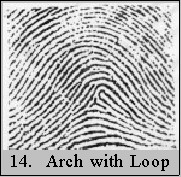 ...By the way, I recognize where you found this picture (Ed's article, where he refered to the work of Beverly Jaegers)... but for sure: this visual example does not related to the 'three or four ridges forming a loop' example that you described.
Unfortunately Ed didn't mention/notice in his article that Beverly Jaegers probably misunderstood the essentials of an arch fingerprint. For, Jaegers is talking in her book about 'arches' that may occure above- and below a loop... however, basically this is an example of fundamental-nonsense because EVERBODY has those elements above- and below the center pattern in each single fingerprint.
Last edited by Martijn (admin) on Mon Sep 13, 2010 4:12 pm; edited 1 time in total
Martijn (admin)- Admin
- Posts : 5261
Join date : 2010-07-23
Location : The Netherlands -
Re: tented arch like loops
sajid nadeem Mon Sep 13, 2010 10:51 am
Last edited by Martijn (admin) on Mon Sep 13, 2010 4:11 pm; edited 1 time in total (Reason for editing : tented arch)
sajid nadeem- Posts : 16
Join date : 2010-08-28
Re: tented arch like loops
sajid nadeem Mon Sep 13, 2010 10:54 am
sajid nadeem- Posts : 16
Join date : 2010-08-28
Re: tented arch like loops
Martijn (admin) Mon Sep 13, 2010 11:02 am
[sajid nadeem wrote:ooooooooopss,,,,, should have written tented arch in place of arch in my previous post
 Hello sajid, yes I noticed your little 'mistake' ... but you can correct that yourself by using the 'edit' button
  ... than you can simply re-write and/or correct your words!]
Martijn (admin)- Admin
- Posts : 5261
Join date : 2010-07-23
Location : The Netherlands -
sajid nadeem- Posts : 16
Join date : 2010-08-28
Re: tented arch like loops
kiwihands Tue Mar 22, 2011 1:54 am
I'm relatively new to this forum, so only just making my way through all these interesting topics. In case you are still watching this topic, here are my two cents' worth...

I completely agree with your views. On the one hand strict categorisation in recognised patterns is indeed necessary for the purpose for identification (as described in the FBI handbook). But this either/or classification doesn't sit well with my perception of palmistry either.
As you say, a well-defined loop with 15 ridges between core and delta and a loop with one ridge and a central triradius look like two very different things, and intuitively (if we see those patterns as manifestations of individual energies) I would agree that their "owners" would exhibit subtle differences.
Ronelle Coburn in "Destiny at your Fingertips" talks about combination patterns - for example the one you mentioned she calls a "loop-tent." Her requirements for a loop-tent are a triradius that is "dead center" and "only a little looping". This is very vague - what's "only a little"?

Here I see the fundamental difference between the FBI approach and the chirologist's approach: categorisation vs. reading/ interpretation.
I personally have four such loop-tents (three of them with a ridge count of 1) and have to say I identify strongly with the tent characteristics. With regard to the "life purpose reading" method, the results I get from counting these prints as combinations (resulting in a value of 2.5, rather than 3 as for a normal loop) also make a lot more sense to me than counting them as strict loops.
I'm still very much in the process of learning - years away from calling myself an expert reader. But seeing that you didn't get very many responses, I'm hoping this will help you on your journey! Please do share your findings if you come across anyone with a questionable print like this and get the chance to quiz them!

kiwihands- Posts : 364
Join date : 2011-01-09
Location : nowhere
Re: tented arch like loops
Lynn Tue Mar 22, 2011 2:33 am
After 41 pages of discussion on Walt Disney's fingerprint, https://www.modernhandreadingforum.com/t469-walt-disney-one-of-his-fingerprints-shows-an-unusual-characteristic I am pretty exhausted about loops vs tented arches!
 But it is fascinating!
Have you posted your 'four such loop-tents (three of them with a ridge count of 1)' anywhere? ( maybe they could lead to 160 pages of discussion!)
Sajid, I think you said you don't have actual pics of the hand in question - are you able to get any? It might create another interesting discussion!

Lynn- Posts : 2461
Join date : 2010-07-24
Location : Devon, England -
Re: tented arch like loops
sajid nadeem Tue Mar 22, 2011 5:02 am
thanks for ur respone;i dont have any pics to share;like kiwihands most of my loops have very low ridge count between delta and core;i will try to find some high resolution camera to take pics and submit.
sajid nadeem- Posts : 16
Join date : 2010-08-28
Re: tented arch like loops
kiwihands Tue Mar 22, 2011 11:56 pm
yes I have been following the discussion about Disney's prints, too, am utterly fascinated by the whole topic. I downloaded the FBI handbook and have studied most of it - the scientist in me relished the very clear-cut criteria for print identification, and I now finally understand what all this talk of deltas and cores was all about.
But it also made me think about the vast difference between the two approaches (classification vs interpretation), and it made me wonder in how far categories used in law enforcement can be transferred to hand reading. Should there be no mixed types of prints in chirology only because the FBI says so?
I can also see a parallel with hand types here: most people have a combination of "elements" and no one would insist that it would have to be one or the other. To have this flexibility with regards to hand types, but not with prints seems illogical to me. But that's just my opinion...

I wonder what other forum members think about this?
My own prints are on my flickr account, and one in particular (right middle finger http://www.flickr.com/photos/58152183@N03/5443093876/) ignited a 4-page discussion here: https://www.modernhandreadingforum.com/t591-life-purpose-reading-please-from-fingerprints.
According to the FBI criteria it is definitely a radial loop, which was Martijn's position, but at first glance it does look like a tented arch (Patti's position). After having read everything I could get my hands on about the significance of both, I have come to the conclusion that both patterns apply to me in part, but not to their full extent. To the radial loop I would say a resounding "Yes" re being an innovator, but a disappointed "I wish" to the ability to control bodily functions such as heart rate mentally. To the tented arch I concede strong ambition, but I have never been a fanatic convert of anything.
All the other prints are also on my flickr. They are more obviously loops, but still have fairly central triradii and low ridge count.
In general I relate more to the tented arch characteristics: reading overall descriptions, I have to agree to everything (and then some, regarding the intensity of those qualities
), whereas reading general loop characteristics I cannot identify at all with some crucial features. Would this be the case if I really had only one tented arch (according to FBI book) plus nine loops I wonder? Looking forward to hearing other people's opinions!
x
kiwihands- Posts : 364
Join date : 2011-01-09
Location : nowhere
Re: tented arch like loops
Lynn Wed Mar 23, 2011 11:10 am
Will reply to some of your points later, if I do it now I'll be late for work! ;-)
Lynn- Posts : 2461
Join date : 2010-07-24
Location : Devon, England -
Re: tented arch like loops
Lynn Sat Mar 26, 2011 2:15 am
kiwihands wrote:Hi Lynn,
yes I have been following the discussion about Disney's prints, too, am utterly fascinated by the whole topic. I downloaded the FBI handbook and have studied most of it - the scientist in me relished the very clear-cut criteria for print identification, and I now finally understand what all this talk of deltas and cores was all about.
But it also made me think about the vast difference between the two approaches (classification vs interpretation), and it made me wonder in how far categories used in law enforcement can be transferred to hand reading. Should there be no mixed types of prints in chirology only because the FBI says so?
I can also see a parallel with hand types here: most people have a combination of "elements" and no one would insist that it would have to be one or the other. To have this flexibility with regards to hand types, but not with prints seems illogical to me. But that's just my opinion...
I wonder what other forum members think about this?
hi, sorry it took me a while to respond. Yes of course there is a difference between the two approaches (classification vs interpretation). FBI is mainly for identification of who commited the crime! (hence the minutae are so important!) But their "rules" are important guidelines in differentiating the various fingerprint types, for all of us, no matter what approach we take to hands.
However, in our day-to-day work, palm readers do not have the luxury of discussing for weeks about a 10x zoom of the print ;-) so we just have to 'plump for' whatever print it appears to be in the moment. In my case Disney's was instantly a radial loop. Patti brought in some good arguments to make me question that in FBI method it could be a tented arch.
re "I can also see a parallel with hand types here: most people have a combination of "elements" and no one would insist that it would have to be one or the other. To have this flexibility with regards to hand types, but not with prints seems illogical to me"
That's a different thing really. Fingerprints are just one feature of the hand, and each classification of print is ruled by one element (or maybe a combination of two elements).
"Hand type" via the elements, involves looking at all features of the hand. eg a person might have fire hand shape, air knuckles, water skin, air length water line, air line going into water quadrant, earth & water fingerprints ...etc. We are all various combinations of all elements.
Lynn- Posts : 2461
Join date : 2010-07-24
Location : Devon, England -
Re: tented arch like loops
kiwihands Sun Mar 27, 2011 10:23 pm
thank you so much for your reply. You approach, to just plumb for what the print appears to be at the moment, seems much more feasible to me than spending ages poring over each questionable print to determine ridges and deltas.
Regarding my remark about prints and elemental hand types, of course you're right, you can't compare the two. It was just the first thing that came to my mind, but a bad example to make. I wasn't so much referring to elements as to the fact that in other aspects of palm reading it is quite rare to find a feature that fits perfectly into one category - instead there is a continuum along which we try to interpret signs. In contrast to that, the FBI classifications put each print in a very neatly defined box, making the decision either/ or
rather than considering combinations.
A better example may have been something like the length of the head line: we read in our books that we can encounter a straight or bent line, but when we see one with only a slight curve we wouldn't give the same interpretation as for one that dips down deeply into the lunar mount.
I find it slightly illogical that there is no such flexible spectrum of interpretation for prints as well, i.e. can't really believe that a well-developed loop of 15 ridges should be treated the same as a single ridge loop with a central triradius. Sticking with the elemental lingo, the latter would, to me, express at least as much fire as water. When you say "perhaps a combination of two elements" I think we are of the same opinion here.
I do realise that I'm really just a spring chicken in this field, with not a great deal of experience. Would love to hear what others think about this!
Thanks for your time Lynn!
kiwihands- Posts : 364
Join date : 2011-01-09
Location : nowhere
Re: tented arch like loops
Patti Mon Mar 28, 2011 5:53 pm
kiwihands wrote:
I find it slightly illogical that there is no such flexible spectrum of interpretation for prints as well, i.e. can't really believe that a well-developed loop of 15 ridges should be treated the same as a single ridge loop with a central triradius. Sticking with the elemental lingo, the latter would, to me, express at least as much fire as water. When you say "perhaps a combination of two elements" I think we are of the same opinion here.
Hi Kiwi,
Support for your thoughts about the likely differences in some kinds of human characteristics based on the number of ridge counts found in a loop, might be found in another manner.
The ridges have a degree of slant to them. Most obviously to do with sensory, friction, and grip. When it's energy that is being transmitted elsewhere, intuitively (including energy work) and by nerve endings (touch), and then consider how the different patterns create ridges leaning from a more basic two directional 'input' as in the basic, simple arch, to something very multi-directional as found in the whorl, and its subcategories of peacocks and double loops.
A tented arch often has a central peak and central upthrust of some sort. Esoterically, symbolically aren't we looking at a pyramid shape? Does energy flow in and out of the fingertips? If so, perhaps the energy can enter more focused and expand. Or, in expression maybe it can pull from a pool of resources and narrow it's focus outward. It would seem the vertical nature itself would illustrate some differences in how a person perceives, and responds to their world. The pattern is more angular and less rounded than a loop or an arch.
A loop elongates a ridge and returns it to the same side of entry only now possibly leaning in the opposite direction (two view points one ridge) A whorl spirals inward, and often back outward. Very multidirectional and increases even more the length of a single ridge.
It would seem adding a single loop (or very low ridge count) would enhance or increase the 'dimensional sensors' represented in the fingerprint that is a basic arch or tented arch.
An increase and decrease in the number of looping and circling ridges would affect the number of horizontal ridges (rows of ridges leaning together in the same direction) above and below the central pattern, too.
Ridge counts are also used in studying syndromes in combination with other features.
Kiwi, I find your fingerprints really fascinating and have been studying them off and on these past few weeks. I'll share on your thread soon some thoughts. It's fun that you share your thoughts and insights about your self here as that peek into your personality gives more understanding into how your fingerprints relate to who you are.


Patti- Posts : 3912
Join date : 2010-07-24
Re: tented arch like loops
jeanette Mon Mar 28, 2011 8:26 pm
Thanks so much for that post. I was thinking exactly the same as Kiwihands and that was what I meant when I posted the question, is there an ideal fingerprint, only Kiwihands phrased it the way I had really wanted to. So thanks to you and Kiwihands we got that great information from you.
Jeanette.

jeanette- Posts : 568
Join date : 2010-07-27
Location : scotland
Re: tented arch like loops
kiwihands Mon Mar 28, 2011 9:19 pm
Thanks heaps for your thoughtful reply. I was hoping you'd be following this and chipping in, what with your special interest in prints and their formation! I have copied your post into my personal compendium of insightful-things-to-ponder-about-palmistry-that-you-can't-find-in-books.

Did you say in another thread that you were thinking about writing a book compiling the results of all your research into this topic?
What a fascinating way of looking at this. Your views make complete sense to me - considering fingerprints as symbols or manifestations of energy flow patterns, all the features that are overlooked by mere classification take on very distinct meanings.
All your interpretations seem very logical - indeed so "obvious" that now I'm wondering how this didn't occur to me before. Haha, I guess this is where lots of experience comes in! I'm also wondering what your birth card may be in Tarot (have my suspicions of course) - would you mind sharing this if you know it, or your birth date? Perhaps as a private message ... I know a lady never tells her age.

Thank you for mentioning the fact that ridge counts are used in studying certain syndromes - a quick search of PubMed turned up 250 results for "dermatoglyphics ridge count"! Woohoo. This snippet I found very odd: "The male schizophrenic patients showed a significantly higher total finger ridge count of each hand and TFRC than the control group. [...] The schizophrenic females had lower ridge count than the control group females." Haha, what do you make of that. The number of patients was probably too low to generalise (76), but certainly food for thought.
I'm honoured that you would find my fingerprints interesting! Thank you for your time; I really look forward to reading some of your thoughts on my thread when you get around to it. I'll always endeavour to give as much detailed and honest feedback as I can - it's the least I can do.
Cheers
*Kiwi*
kiwihands- Posts : 364
Join date : 2011-01-09
Location : nowhere
Re: tented arch like loops
Lynn Mon Mar 28, 2011 10:54 pm
re Kiwi
sorry I have a bee in my bonnet about elemental hand reading ;-) cos many people think it only applies to handshape. In handshape I would agree about the continuum (eg slightly narrow fire hand with medium fingers = fire with a bit of water etc.), and I perfectly understand what you are saying about things like 'degrees of curvature of headline'.I wasn't so much referring to elements as to the fact that in other aspects of palm reading it is quite rare to find a feature that fits perfectly into one category - instead there is a continuum along which we try to interpret signs.
Like Patti, I also think of the lines and skin ridges as energy flows. Patti's example of a classic tented arch with a central triradius funnelling the energy up and out is how I think of it.
re Kiwi
can't really believe that a well-developed loop of 15 ridges should be treated the same as a single ridge loop with a central triradius. Sticking with the elemental lingo, the latter would, to me, express at least as much fire as water.
hmmm, single ridge loop with central triradius, sounds like no ridge count so in FBI that would be a tented arch! (don't get us started on that!!
 ). However, in a reading I would think the water element of even a single ridge loop modifies the intensity of the fire tented arch in the personality. But that's just my way of thinking about it, I don't think I've ever read in any palmistry books about such compensatory features in interpretation of fingerprints. (till Patti writes her book!!). Tho of course, as Patti said, the ridge count is very important in scientific terms.
Kiwi, I find your fingerprints really fascinating too! The one we spoke about earlier looked like a tented arch to me, as it did to Patti. But on looking again I thought I saw a couple of single ridge loops in opposite directions (maybe I am hallucinating!). I look forward to Patti's input on your thread, cos I am not sure what I am seeing in your prints. (oh no, here we go again!! Disney deja-vu!!
) I also appreciate your input and feedback.Jeanette, great that this thread has helped re your "ideal fingerprint" question.
I just LURVE talking about dermatoglyphics!

Lynn- Posts : 2461
Join date : 2010-07-24
Location : Devon, England -
Re: tented arch like loops
Patti Tue Mar 29, 2011 4:34 am
jeanette wrote:Hi Patti,
Thanks so much for that post. I was thinking exactly the same as Kiwihands and that was what I meant when I posted the question, is there an ideal fingerprint, only Kiwihands phrased it the way I had really wanted to. So thanks to you and Kiwihands we got that great information from you.
Jeanette.
Thank you Jeanette!!
Patti- Posts : 3912
Join date : 2010-07-24
Re: tented arch like loops
Patti Tue Mar 29, 2011 4:53 am
kiwihands wrote:Hi Patti,
Thanks heaps for your thoughtful reply. I was hoping you'd be following this and chipping in, what with your special interest in prints and their formation! I have copied your post into my personal compendium of insightful-things-to-ponder-about-palmistry-that-you-can't-find-in-books.
Did you say in another thread that you were thinking about writing a book compiling the results of all your research into this topic?
What a fascinating way of looking at this. Your views make complete sense to me - considering fingerprints as symbols or manifestations of energy flow patterns, all the features that are overlooked by mere classification take on very distinct meanings.
All your interpretations seem very logical - indeed so "obvious" that now I'm wondering how this didn't occur to me before. Haha, I guess this is where lots of experience comes in! I'm also wondering what your birth card may be in Tarot (have my suspicions of course) - would you mind sharing this if you know it, or your birth date? Perhaps as a private message ... I know a lady never tells her age.
Thank you for mentioning the fact that ridge counts are used in studying certain syndromes - a quick search of PubMed turned up 250 results for "dermatoglyphics ridge count"! Woohoo. This snippet I found very odd: "The male schizophrenic patients showed a significantly higher total finger ridge count of each hand and TFRC than the control group. [...] The schizophrenic females had lower ridge count than the control group females." Haha, what do you make of that. The number of patients was probably too low to generalise (76), but certainly food for thought.
I'm honoured that you would find my fingerprints interesting! Thank you for your time; I really look forward to reading some of your thoughts on my thread when you get around to it. I'll always endeavour to give as much detailed and honest feedback as I can - it's the least I can do.
Cheers
*Kiwi*
Hi Kiwi,
I'm flattered to be included in your "personal compendium of insightful-things-to-ponder-about-palmistry-that-you-can't-find-in-books" !!! That is so cool!
My number based on my birth date is 9, The Hermit. Which card were you thinking?
Isn't PubMed awesome!? You can get lost in there for hours as one link leads you to many more.
Coincidentally, I came across this link to a study that answers your question:
http://www.ncbi.nlm.nih.gov/pubmed/20071110
Interestingly, in this study on Chinese and Malaysian people, men tend to normally have a lower average ridge count than women. So, it would seem that the study you found on the schizophrenic patients shows that when the counts are switched and the males have higher counts and the females lower counts, it drives them 'crazy'.
But that's a whole new topic!
Patti- Posts : 3912
Join date : 2010-07-24
Re: tented arch like loops
Patti Tue Mar 29, 2011 5:14 am
Lynn wrote:
Kiwi, I find your fingerprints really fascinating too! The one we spoke about earlier looked like a tented arch to me, as it did to Patti. But on looking again I thought I saw a couple of single ridge loops in opposite directions (maybe I am hallucinating!). I look forward to Patti's input on your thread, cos I am not sure what I am seeing in your prints. (oh no, here we go again!! Disney deja-vu!!
I just LURVE talking about dermatoglyphics!
I saw the same thing Lynn! But the loop from the left, is spoiled by the appendage - otherwise, it'd be worth at least 10 to 15 pages of discussion!! Yet, that's only according to classification, perhaps there's something to these short spike like ending ridges sitting atop a recurve on a loop. A laser beam of energy or a focused antennae, or whatever..?
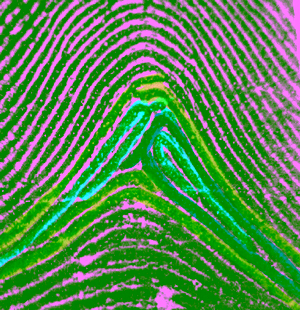
(this is from printing out the image and tracing with colored highlighters - just for fun - so I'm sure clarity is lost as well as I wasn't trying to stay perfectly on the lines)
I don't want to switch subjects here.
I'll post tomorrow on Kiwi's thread. As they say on the social networks and to quote you "we'll share some of the LURVE.
Patti- Posts : 3912
Join date : 2010-07-24
Re: tented arch like loops
Martijn (admin) Wed Mar 30, 2011 2:52 pm
Patti wrote:kiwihands wrote:Hi Patti,
Thanks heaps for your thoughtful reply. I was hoping you'd be following this and chipping in, what with your special interest in prints and their formation! I have copied your post into my personal compendium of insightful-things-to-ponder-about-palmistry-that-you-can't-find-in-books.
Did you say in another thread that you were thinking about writing a book compiling the results of all your research into this topic?
What a fascinating way of looking at this. Your views make complete sense to me - considering fingerprints as symbols or manifestations of energy flow patterns, all the features that are overlooked by mere classification take on very distinct meanings.
All your interpretations seem very logical - indeed so "obvious" that now I'm wondering how this didn't occur to me before. Haha, I guess this is where lots of experience comes in! I'm also wondering what your birth card may be in Tarot (have my suspicions of course) - would you mind sharing this if you know it, or your birth date? Perhaps as a private message ... I know a lady never tells her age.
Thank you for mentioning the fact that ridge counts are used in studying certain syndromes - a quick search of PubMed turned up 250 results for "dermatoglyphics ridge count"! Woohoo. This snippet I found very odd: "The male schizophrenic patients showed a significantly higher total finger ridge count of each hand and TFRC than the control group. [...] The schizophrenic females had lower ridge count than the control group females." Haha, what do you make of that. The number of patients was probably too low to generalise (76), but certainly food for thought.
I'm honoured that you would find my fingerprints interesting! Thank you for your time; I really look forward to reading some of your thoughts on my thread when you get around to it. I'll always endeavour to give as much detailed and honest feedback as I can - it's the least I can do.
Cheers
*Kiwi*
Hi Kiwi,
I'm flattered to be included in your "personal compendium of insightful-things-to-ponder-about-palmistry-that-you-can't-find-in-books" !!! That is so cool!
My number based on my birth date is 9, The Hermit. Which card were you thinking?
Isn't PubMed awesome!? You can get lost in there for hours as one link leads you to many more.
Coincidentally, I came across this link to a study that answers your question:
http://www.ncbi.nlm.nih.gov/pubmed/20071110
Interestingly, in this study on Chinese and Malaysian people, men tend to normally have a lower average ridge count than women. So, it would seem that the study you found on the schizophrenic patients shows that when the counts are switched and the males have higher counts and the females lower counts, it drives them 'crazy'.
Patti, you've misread the summary of the Chinese/Malaysian study: they only consider 'ridge density' - which is not related to the fingerprint pattern, nor the 'ridge count'..
While the study mentioned by Kiwihands only considers the 'ridge count' assessment - which does relate to the fingerprint pattern.
By the way, men typically have a HIGHER 'ridge count' than women (because whorls are usually more commen in the hands of men, and arches usually more common in women). And men typically have a LOWER 'ridge density' than women.
PS. Cummins & Midlo described the typical sexe differences for 'ridge count' + 'ridge density' (= ridge count per centimer) [see page 272 + 273 in: Finger Prints, Palms & Soles].
Martijn (admin)- Admin
- Posts : 5261
Join date : 2010-07-23
Location : The Netherlands -
Re: tented arch like loops
Patti Wed Mar 30, 2011 3:21 pm
Patti- Posts : 3912
Join date : 2010-07-24
Re: tented arch like loops
Patti Wed Mar 30, 2011 3:34 pm
"In the past it has been assumed that the fingerprints of women tend to have "fine" epidermal ridge detail while men have "coarse" ridge detail. Past studies have examined this hypothesis but have not clearly demonstrated if observed differences are statistically significant."
"Application of Bayes' theorem suggests that a given fingerprint possessing a ridge density of 11 ridges/25 mm2 or less is most likely to be of male origin. Likewise a fingerprint having a ridge density of 12 ridges/25 mm2 or greater is most likely to be of female origin, regardless of race."
But, where does this leave us with the schizophrenics and the differences in the ridge counts?
Last edited by Patti on Wed Mar 30, 2011 3:39 pm; edited 2 times in total (Reason for editing : correction)
Patti- Posts : 3912
Join date : 2010-07-24
Page 1 of 2 • 1, 2
Similar topics» Tented Arch or Radial Loop
» Count ridges in Simple and tented arch
» Arch fingerprints: what are the facts?
» COMPOSITES (Loops / Whorls): Central Pockets, Lateral Pockets, Twin Loops & Accidentals
Modern Hand Reading Forum - Discover the language of your hands: palm reading & palmistry forum! :: III - MODERN HAND READING - Various systems for reading hands! :: IIIa - Modern Palmistry: general topics, questions :: IIIg - Dermatoglyphics + fingerprints
» Can anyone read it for me?
» Square on Marriage line
» Cross in mount Jupiter
» clinodactyly: top phalanges bending towards Mercury finger
» Can anybody please read this hand
» Nisha Ghai
» Absolutely non-sense career till now
» Fate Destiny Line -
» VIII - Palmistry books TOP 100 - listed by 'Amazon Sales Rank'!
» Stewart Culin - Palmistry in China and Japan
» Herbert Giles - Palmistry in China
» life line forks
» Astro-Palmistry files
» unique lines on Saturn mount